Understand key differences in cutting angles, capacity, and use for these saws. If you’re tackling a new workshop setup or just upgrading your tools, you’ve probably wondered about the exact difference between miter saw and table saw. It’s a common confusion, but don’t worry—you are not alone. A miter saw is your go-to for precise angled cuts on smaller pieces, like trim and crown molding. It’s all about crosscuts and miters. A table saw, on the other hand, is the powerhouse for ripping large sheets and long boards down to size. The choice really comes down to what you plan on cutting most often.
Think about the projects you do. Are you installing baseboards or building cabinets? For quick, repeatable angled cuts, the miter saw is your best freind. For breaking down plywood or creating dados, the table saw takes the lead. Both are essential for a serious woodworker, but knowing thier strengths will save you time and frustration. Let’s break down these differences so you can pick the right saw for your next project.
Product Comparison Table: 10 Best Difference Between Miter Saw And Table Saw
| Image | Why We Like This Product | Editor’s Rating | |
 |
VEVOR Precision Miter Gauge, Standard Slot 3/4” x 3/8”,…
|
9.6 |
Read Review |
 |
VEVOR Precision Miter Gauge, Standard Slot 3/4” x 3/8”,…
|
9.4 |
Read Review |
 |
VEVOR Precision Miter Gauge, Standard Slot 3/4” x 3/8”,…
|
9.2 |
Read Review |
 |
O’SKOOL Miter Bar Miter Slot Runner Slider Bars for…
|
8.9 |
Read Review |
 |
GOINGMAKE Compact Table Saw Miter Gauge with 360mm Fence…
|
8.7 |
Read Review |
 |
Neoteck 0-1” Digital Dial Indicator Table Saw Gauge Suitable…
|
8.5 |
Read Review |
 |
KETIPED 2 Pack Crosscut Sled for Table Saw, Miter…
|
8.3 |
Read Review |
 |
JCFANTS Aluminum Table Saw Precision Miter Gauge Works w/Table…
|
8.0 |
Read Review |
 |
GOINGMAKE Table Saw Miter Gauge with Micro Adjustable Flip…
|
7.8 |
Read Review |
 |
Kreg Precision Miter Gauge System – Adjustable Table Saw…
|
7.6 |
Read Review |
Quick Review For Top 10 Difference Between Miter Saw And Table Saw
VEVOR Precision Miter Gauge, Standard Slot 3/4'' x 3/8'', Aluminum Alloy Table Saw Miter Gauge with 19-35 in Grating 15 Angle Stops Adjustable Spring Loaded Plunger and Removable Disc, for Woodworking

The VEVOR Precision Miter Gauge is built for woodworkers who need consistent, accurate crosscuts on their table saw. It fits standard 3/4 x 3/8 inch slots, but its a good idea to measure your saw’s slot first to be sure. The removable disc lets it work with both T-shaped and U-shaped slots, so it should fit most common table saw brands.
Cutting precise angles is straightforward. The solid aluminum head has 15 positive stop holes.
One is set at 90 degrees, with seven more on each side at 15, 22.5, 30, 35, 45, 60, and 67.5 degrees. That covers almost every angle you will need for typical woodworking projects. If you need a custom angle, the gauge adjusts smoothly, so you can dial in exactly what you want without guessing.
Setup is simpler than you might expect. The miter gauge ships partially assembled, so you only need to attach a few core parts. There is no need to sort through a pile of tiny screws or washers.
This keeps your setup time short and helps maintain the accuracy of your measurements from the start.
Operation is easy thanks to the steel miter bar. It has an adjustable spring plunger on the side. If you notice any wobble or gap when you slide the gauge into the table slot, just use the included hex wrench to adjust the plunger. This gives you a snug, secure fit that reduces wear and keeps your cuts clean.
VEVOR Precision Miter Gauge, Standard Slot 3/4'' x 3/8'', Aluminum Alloy Table Saw Miter Gauge with 18 in Grating 15 Angle Stops Adjustable Spring Loaded Plunger and Removable Disc, for Woodworking

The VEVOR Precision Miter Gauge, Standard Slot 3/4” x 3/8”, Aluminum Alloy Table Saw Miter Gauge with 18 in Grating 15 Angle Stops Adjustable Spring Loaded Plunger and Removable Disc is built for woodworkers who need reliable angle control. It’s designed to fit most standard table saw slots measuring 3/4 x 3/8 inches (19 x 9.5 mm). Before you buy, measure your table saw slots to be sure it will fit. The detachable disc makes it work with both T-shaped and U-shaped slots.
This means it can work with many table saw brands, giving you a solid upgrade for precision work.
You get precise angle cutting with the adjustable solid aluminum head. It has 15 positive stop holes for repeatable accuracy. One stop is set at 90 degrees, with seven more on each side at 15, 22.5, 30, 35, 45, 60, and 67.5 degrees. These cover most common woodworking angles. For more detailed cuts, you can adjust the gauge proportionally.
This helps you hit exact angles quickly and without fuss.
The miter gauge comes partially assembled to save you time. You won’t have to sort through a pile of tiny parts. Just attach a few key components, and you’re ready to work. It keeps your measurements accurate without the usual setup headache.
Operation is simple. The steel miter bar has an adjustable spring plunger on the side.
VEVOR Precision Miter Gauge, Standard Slot 3/4'' x 3/8'', Aluminum Alloy Table Saw Miter Gauge with 24 in Grating 15 Angle Stops Adjustable Spring Loaded Plunger and Removable Disc, for Woodworking

The VEVOR Precision Miter Gauge, Standard Slot 3/4” x 3/8”, Aluminum Alloy Table Saw Miter Gauge with 24 in Grating 15 Angle Stops Adjustable Spring Loaded Plunger and Removable Disc is built for straight-to-the-point woodworking accuracy. You get a tool that fits most standard table saw slots measuring 3/4 by 3/8 inches. Before you buy, just measure your saw’s slots to be sure.
It works with both T-shaped and U-shaped slots thanks to the detachable disc, so it’s compatable with a wide range of table saw brands. This is a solid upgrade if you want cleaner cuts without fussing with your old setup.
Cutting angles is where this gauge shines. The adjustable solid aluminum head has 15 positive stop holes. One hole locks at 90 degrees, with seven more on each side at 15, 22.5, 30, 35, 45, 60, and 67.5 degrees.
That covers most common woodworking angles right out of the box. For trickier cuts, the gauge adjusts smoothly so you can dial in precise angles without guesswork. The scale is etched using laser engraving, so it stays readable over time.
Setting it up is simple because it ships partially assembled. You won’t be digging through a bag of tiny parts. Just attach a few core components and your ready to go. This keeps the accuracy intact while saving you from typical assembly headaches.
O'SKOOL Miter Bar Miter Slot Runner Slider Bars for Table Saw Sled and Crosscut Sled, 17 inch (430mm), 2 Pack, PTA024

The O’SKOOL Miter Bar Miter Slot Runner Slider Bars, model PTA024, is a 2-pack set of 17 inch (430mm) aluminum runners designed for table saw sleds and crosscut sleds. These bars are built to help you get accurate cuts with less fuss.
The first thing you will notice is the roundover design on the edges. This makes it easy to slide the bar into your miter slot without catching or jamming. The expansion collars are a key feature.
They tighten up to create zero clearance between the bar and the track. This stops any side-to-side wiggling. Less movement means more accurate cuts for your woodworking projects.
These bars are made from a premium aluminum alloy. They feel solid and durable. You can expect them to hold up over time, even with regular use in your shop. The standard dimensions are 3/4 inch by 3/8 inch. This size fits into most common T-shaped and U-slot miter tracks.
Just be aware that they are not compatable with the 5/8 inch miter slots. Measuring your slot before you start is a good idea.
Installing these bars is straight forward. They come with mounting templates and an instruction manual to guide you. You get 12 #8 wood screws (3/4 inch long) and 8 1/4-20 UNC countersunk machine screws for securing the bars. A 2.5mm Allen key wrench is also included for adjustments.
GOINGMAKE Compact Table Saw Miter Gauge with 360mm Fence and Multifunction Flip Stop and Positive Angle Stops, Miter Gauge for Table Saw Accessories, for Woodworking Cuts, Fits 3/4"x3/8" Slot
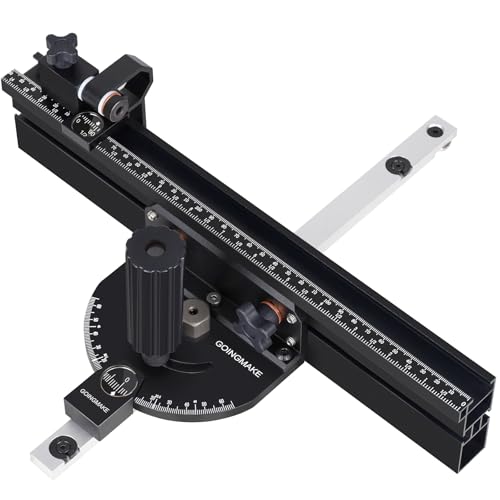
The GOINGMAKE Compact Table Saw Miter Gauge with 360mm Fence and Multifunction Flip Stop and Positive Angle Stops is a practical tool for anyone who does woodworking and needs precise, repeatable cuts. It is designed to fit into the 3/4 inch by 3/8 inch slot on most table saws, making it a versatile upgrade for your workshop. This miter gauge helps you make accurate crosscuts and miter cuts easily. It has 11 positive angle stops for the most common angles you will use.
You can quickly set it to 90, 60, 45, 30, 22.5, 15, and 0 degrees on both sides, including negative angles like -60 and -45. The engineering plastic locking handle and metal stops let you lock the angle securely. If you need a custom angle between -60 and 60 degrees, you can use the clear laser scales for a precise setup. This makes it a solid choice for repeated woodworking angle cuts. The compact size is a key feature, especially if you use a portable jobsite table saw.
The miter bar and the fence are both 360mm long, with clear laser markings in both millimeters and inches. The body is solid and stable, yet easy to carry and store. It is a good upgrade for most table saws because it does not take up much space but still provides accuracy. The multifunction flip stop is smart and solid. It includes a locating pin that works for both square and angled workpieces. You can read the scales easily thanks to a magnifying glass and a precision pointer.
Neoteck 0-1'' Digital Dial Indicator Table Saw Gauge Suitable for Table Saws with a Groove Width of 3/4" (19mm) or more for Aligning and Calibrating Work,Shop Machinery,Band Saw and Drill Press-Silver

The Neoteck 0-1” Digital Dial Indicator Table Saw Gauge is a tool built for one thing: getting your shop machinery aligned and calibrated with less guesswork. It is designed to fit standard miter grooves, specifically the 3/8 inch by 3/4 inch size, so it works with most table saws that have a groove width of 3/4 inch (19mm) or more. If your groove is a bit wider, you can adjust it using the screws for a snug fit. The digital dial indicator is the core of this system.
It measures from 0 to 1 inch (0 to 25.4 mm) and gives you a high resolution of 0.0005 inch (0.01 mm). You can switch between inch and millimeter readings with a simple button, and there is a zero-setting function to make your measurements relative. Compared to an old analog dial gauge, this digital version is quicker to read and easier to use when you are checking blade and fence alignment, arbor run-out, or miter slot squareness. The gauge comes with two CNC-machined anodized aluminum bars.
These bars are adjustable and have three chute partitions for better stability inside the miter slot. Each bar has six holes for mounting the digital indicator, so you can position it exactly where you need it, regardless of the chamfer or blade distance on your machine. The whole setup is made to stay tight even if the miter slot isnt perfectly uniform along its length. Installation is fairly simple.
KETIPED 2 Pack Crosscut Sled for Table Saw, Miter Slot Runners, 3/4" x 3/8" x 17" Premium UHMW Miter Bar with Predrilled Holes & Screws Ideal for U Tracks, Router Table, Bandsaw, Coping Sled,MGJ-105W

The KETIPED 2 Pack Crosscut Sled for Table Saw, Miter Slot Runners, 3/4″ x 3/8″ x 17″ Premium UHMW Miter Bar with Predrilled Holes & Screws Ideal for U Tracks, Router Table, Bandsaw, Coping Sled, MGJ-105W is a practical set for anyone who does woodworking. You get two miter bars and some self-tapping screws in the package. That is everything you need to start building a better sled.
These bars are made from ultra-high molecular weight polyethylene, or UHMW.
This material is super wear resistant. It also has self-lubricating properties, which means it slides smoothly without needing extra grease or wax. The plastic is strong and won’t react with chemicals. It also resists aging, so it should last a long time in your shop. Unlike wood, these bars will not swell or shrink when the humidity changes. They stay the same size all year round.
They are also easy to clean, just wipe them off.
Each bar measures 17 inches long, 3/4 inches wide, and 3/8 inches thick. That is 43mm by 19mm by 9.8mm if you prefer metric. The dimensions are standard for most table saw miter slots. You get a precise fit without too much wobble. Each rod comes with five pre-drilled holes that are also countersunk. This design lets you insert the screws flush with the surface. Nothing will rub against the slot or your workpiece.
JCFANTS Aluminum Table Saw Precision Miter Gauge Works w/Table Saws, Band Saw and Router Table, Includes Multi T–Track Fence w/Scale, T-track Flip Stop(Red)

The JCFANTS Aluminum Table Saw Precision Miter Gauge is built to handle cross cuts on your table saw, band saw, or router table. It comes with a multi T-track fence that has a scale and a T-track flip stop. The core of the unit is a solid aluminum head that is 200 inches thick. That head is machined with 120 positive stop holes, giving you 27 angle stops in 5-degree increments. The laser marking on the head is friction-resistant, so the numbers should stay readable over time.
The miter gauge is made from a high quality steel plate, which gives it good stability for your cutting work.
The aluminum fence that comes with it has 45 degree ends. These ends help support your workpiece, and you can also mount the fence to other miter gauges if you need to. The fence includes a handy aluminum flip stop. This flip stop is design for repetitive angled cuts. You can flip it out of the way quickly when you don’t need it.
The fence has a metric scale printed right on its surface. It also has a tenoning function. The steel miter bar is equipped with a metal part that helps it slide smoothly in your miter slot.
One of the useful features is the precision micro adjustable flip stop. It works with most miter gauges because it mounts on an off-set track on the back of the fence. The fence bracket is universal and pivots to lock.
GOINGMAKE Table Saw Miter Gauge with Micro Adjustable Flip Stop and Extendable Fence and Quick Angle Stop for Table Saw Band Saw Router Table Fit 3/8 x 3/4" T Slot for Woodworking Crosscut, Miter Cut

The GOINGMAKE Table Saw Miter Gauge with Micro Adjustable Flip Stop and Extendable Fence and Quick Angle Stop is a solid tool for crosscuts and miter cuts on your table saw, band saw, or router table. It fits standard 3/8 x 3/4 inch T-slots and U-slots, so it should work with most setups you have.
You get a micro adjustable flip stop that lets you dial in cuts down to 0.001 inch. That is very precise. The stop is stable and wont shake during use, which makes repeat cuts reliable.
There is a locating pin for square or angled workpieces, and the magnifying glass helps you read the scales clearly even in low light.
Setting up for zero is fast. You dont need extra tools. Just move the fence close to the blade, leaving a 1 to 3mm gap. Slide the flip stop to touch the blade, then rotate the zero calibration knob to align the zero scale. Thats it. This feature also helps prevent kickback, keeping your work safer.
The angle setup is straight forward.
There are 11 positive stops at common angles like 90, 60, 45, 30, 22.5, and 15 degrees, plus negative angles. The lock holds securely so you can cut angles from -60 to 60 degrees using the clear laser scales. No guessing required.
The fence extends to support cuts up to 36 inches. The standard size is 19.5 inches, which is good for most work. When you need more, just pull out the extension. It includes both inch and mm scales.
Kreg Precision Miter Gauge System – Adjustable Table Saw Miter Gauge Fence – High Accuracy Angle Cutting Tool – KMS7102
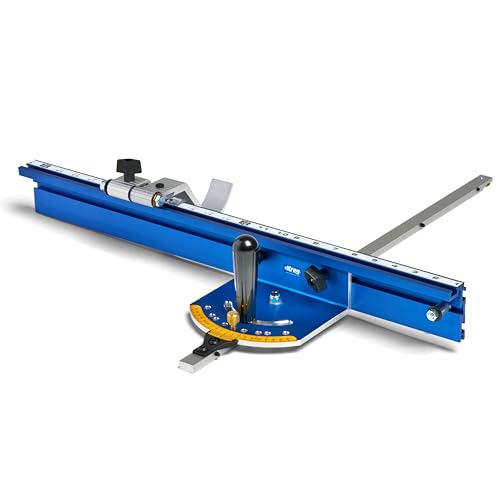
The Kreg Precision Miter Gauge System KMS7102 is a complete miter gauge solution built for accurate, repeatable angle cuts on your table saw. It comes with an adjustable fence that helps you get consistent results across all your woodworking and shop projects. This system is not just another add-on; it is a tool designed to improve how you work.
High-accuracy angle control is at the core of this system.
It is engineered to give you precise miter cuts, which means less guesswork and more consistency. Whether you are making picture frames, crown molding, or furniture joints, this gauge helps you hit your angles every time. The setup is straightforward, so you can focus on the cut instead of fiddling with the tool.
The operation is smooth and controlled. The gauge glides easily in your table saws miter slots, giving you stable, repeatable cutting performance.
You won’t have to fight with sticking or wobbling. This stability reduces the chance of errors and makes each cut feel more predictable. It is a simple improvement that makes a big difference in the shop.
Heavy-duty construction ensures this tool can handle frequent use. It is built with durable materials that stand up to the demands of both professional workshops and DIY spaces. You dont have to worry about it wearing out after a few projects.
Difference Between Miter Saw And Table Saw Buying Guide
The difference between miter saw and table saw is their primary cut type. A miter saw cuts across the grain for angles and trim work. A table saw rips with the grain for sheets and boards. That simple fact changes everything about how you use each tool.
You might be wondering which one you actually need. Maybe you’ve already bought a saw and it’s not working for your projects. Let’s break it down so you can pick right the first time.
Cut Types: Crosscuts vs Rip Cuts
Miter saws make crosscuts—clean cuts across the width of a board. Perfect for picture frames, baseboards, or crown molding. Table saws make rip cuts—cuts along the boards length. That means cutting plywood sheets down or making a 2×4 thinner. If you need angled cuts for trim, go miter. If you need straight cuts for furniture, go table.
Portability and Workspace
Miter saws are light and compact. You can set one up on sawhorses in your driveway. Table saws are heavy monsters that need a dedicated spot in your shop. Do you have a garage or a small apartment balcony? Think about where you’ll actually use this thing.
Accuracy and Repeatability
Miter saws shine for repeatable crosscuts. Set the angle once, cut 50 pieces exactly the same. Table saws need jigs and sleds for that kind of consistency. But a table saw gives you dead-straight rip cuts that a miter saw just can’t touch. Which matters more for your next project?
Safety and Learning Curve
Miter saws are easier for beginners. The blade pulls down onto the material. Table saws push material into the blade—that’s scarier and needs more caution. Have you ever had wood kick back at you? Table saws can do that if you’re not paying attention. Miter saws are more forgiving for new woodworkers.
Pick the saw that matches your work. Trim and angles mean miter saw. Panels and furniture mean table saw. Or get both if your budget allows—thay complement each other beautifully.
Frequently Asked Questions About Difference Between Miter Saw And Table Saw
What is teh main difference between a miter saw and a table saw?
A miter saw is for cutting across the grain of a board. It makes crosscuts, miter cuts, and bevel cuts. You bring the saw blade down to the wood. A table saw is for cutting along the grain. It makes rip cuts. You push the wood through the spinning blade. So, miter saws cut width, table saws cut length.
Which saw is better for cutting angles?
The miter saw is your best friend for angles. It’s designed to make precise miter and bevel cuts easily. You just adjust the saw’s angle and cut. A table saw can cut angles too, but it’s more complicated. You need to set up a jig or tilt the blade. For crown molding or picture frames, stick with a miter saw.
Can a table saw replace a miter saw?
Not really. A table saw can do some things a miter saw does, but not as well. It’s hard to cut long boards accurately on a table saw without extra setup. A miter saw is faster and safer for crosscutting and angled cuts. Most workshops have both. They complement each other.
Which saw is safer for beginners?
A miter saw is genrally safer for beginners. The blade moves down onto the wood, and the wood stays still. Your hands are away from the blade. A table saw requires pushing wood through a spinning blade, which has more risk of kickback. Always read the manual and use safety gear.
What type of cuts does a table saw excel at?
A table saw excels at rip cuts (cutting boards lengthwise) and making consistent widths. You can also cut dadoes, rabbets, and tenons with the right blades and accessories. It’s perfect for breaking down large sheets of plywood or making furniture parts.
Do I need both saws for home projects?
It depends on your projects. If you do trim work, baseboards, or simple frames, a miter saw is enough. If you build furniture, cabinets, or decks, a table saw is very helpful. Many DIYers start with a miter saw then add a table saw later. Start with the saw that fits your most common tasks.
Which saw is more portable?
A miter saw is more portable. It’s compact and can be set up on a workbench or stand. A table saw is heavier and bigger, taking up more floor space. If you move your saw around often, a miter saw is easier to transport.
In Summary
Choosing the right saw starts with understanding their distinct cutting roles. Think about the projects you handle most often. If you need to cut long boards down to size, a table saw is your best friend. It handles ripping and crosscutting large sheets with ease. On the other hand, if your work focuses on framing, trim, or angled cuts, a miter saw is more practical. It gives you fast, accurate crosscuts and miter angles without much setup. Your workshop is about matching the tool to the task, not the other way around.
Here’s the simple truth: the difference between miter saw and table saw comes down to how you cut. A miter saw cuts with the blade moving down onto the workpiece, great for precise angles and shorter pieces. A table saw cuts with the blade rising up through the material, perfect for ripping and handling larger stock. Don’t overthink it—pick the one that fits your most common cuts. I’ve seen many people start with one and add the other later. That’s a smart move. You’ll get more done with less hassle.