Cutting metal with a jigsaw can be a real pain. You know the struggle—blades snapping, sparks flying, and that awful screeching noise. Finding the right jigsaw blades for metal makes all the difference. It’s not just about getting through the material; it’s about getting a clean cut without destroying your workpiece or your sanity. Trust me, I’ve been there with a box of cheap blades that left me with more frustration than progress.
But here’s the good news: you don’t need to guess anymore. We’ve tested a bunch of blades so you don’t have too. From thin sheet metal to thicker steel plates, we found which ones actually hold up. No fluff, just real results. Ready to ditch the broken blades and start cutting like a pro? Let’s jump in.
Product Comparison Table: 10 Best Jigsaw Blades For Metal
| Image | Why We Like This Product | Editor’s Rating | |
 |
50 Piece Contractor Jigsaw Blades Set with Storage Case,…
|
9.9 |
Read Review |
 |
Jigsaw Blades, 10 Piece Jig Saw Blades, Assorted T-Shank…
|
9.7 |
Read Review |
 |
Craluuur 30PCS Jigsaw Blades Set, Assorted T-Shank Jig Saw…
|
9.4 |
Read Review |
 |
Bosch TPM005 5 pc. Pro-Metal T-Shank Jig Saw Blade…
|
9.2 |
Read Review |
 |
Bosch T5002 10 pc. T-Shank Jig Saw Blade Set…
|
8.9 |
Read Review |
 |
Diablo Bi-Metal Jig Saw Blades for Medium Metal -…
|
8.7 |
Read Review |
 |
Bosch T321AF3 3 pc. 5-1/4 in. 21 TPI Speed…
|
8.4 |
Read Review |
 |
Bosch T118GFS 5-Piece 3-1/4 in. 36 TPI Basic for…
|
8.2 |
Read Review |
 |
Bosch T121AF3 3-Piece 3-5/8 In. 21 TPI Speed for…
|
7.9 |
Read Review |
 |
14 PCS U-Shank Jig Saw Blade Set, Jigsaw Blades…
|
7.7 |
Read Review |
Quick Review For Top 10 Jigsaw Blades For Metal
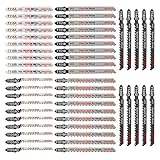
50 Piece Contractor Jigsaw Blades Set with Storage Case, Assorted T-Shank Jig Saw Blades for Wood, Plastic and Metal Cutting(T118A,T118B,T101AO,T101B,T101BR,T144D)
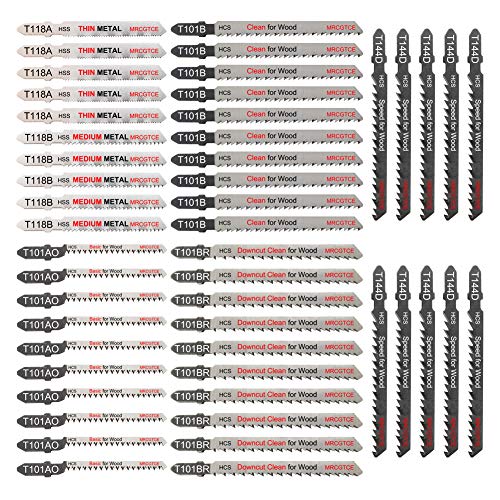
The 50 Piece Contractor Jigsaw Blades Set with Storage Case, Assorted T-Shank Jig Saw Blades for Wood, Plastic and Metal Cutting(T118A,T118B,T101AO,T101B,T101BR,T144D) is a straightforward kit built for getting the job done. You get fifty blades in one case, so you are not running to the hardware store mid-project. The set covers the most common cuts without any fuss.
Let’s talk about what is inside. You have T118A and T118B blades. These are for metal cutting.
If you need to cut through steel sheets or aluminum, grab one of these. They are fine-tooth blades designed to handle tough materials without bending. Then there are the T101AO, T101B, and T101BR blades. These are your go-to for wood. The T101AO is for clean, splinter-free cuts in softwoods and plywood. The T101B is a general-purpose blade for straight cuts in wood.
The T101BR has a reverse tooth design, which helps reduce splintering on the top surface when you are cutting laminate or veneered boards. Finally, the T144D is a thicker blade for fast, rough cuts through thicker wood or even plastic. It clears the dust easily, so you don’t get bogged down.
All blades use the T-shank design. That means they fit most modern jigsaws from brands like Bosch, Makita, DeWalt, and Milwaukee. You just push them in and lock them. No screws to lose.
Jigsaw Blades, 10 Piece Jig Saw Blades, Assorted T-Shank jig Saw Blades for Wood, Metal and Plastic Cutting(T111D, T101AO, T101BR, T101D, T101B, T118A, T118B, T144D, T244D,T111C)

The Romeda 10 Piece Assorted T-Shank Jig Saw Blades set gives you a practical mix of blades for cutting wood, metal, and plastic. Each pack contains ten different models, so you’re ready for a variety of jobs without buying separate packs. The set includes T118A and T118B blades for basic metal cutting, T101AO, T101D, T101B, and T101BR for clean cuts in wood, T144D, T244D, and T111D for faster wood cutting, and a T111C for general basic wood use.
This means you can switch from cutting a metal sheet to a piece of hardwood without stopping.
The blades use a T-shank design, which is the standard for most modern jigsaws. This shape gives you a secure grip and good stability while cutting. You don’t need any screws to install them, just slide the blade in and it locks tight. That also reduces the chance of the blade breaking at the connection point.
The material is SK5 high carbon steel, which Romeda says is about 50 times harder than standard CRV steel. This makes the blades cut cleanly and quickly, and they hold up well over time. You should get decent wear resistance, so they don’t dull after a few uses.
These blades work with over 90% of power curve saws, so they will likely fit your tool. They handle a wide range of materials beyond just wood and metal. You can use them on cork, plastic, construction lumber, and even some iron.
Craluuur 30PCS Jigsaw Blades Set, Assorted T-Shank Jig Saw Blades for Wood, Metal & Plastic Cutting(T101AO, T101B, T101BR, T118A, T118B, T144D, T244D, T111C, T127D)

The Craluur 30PCS Jigsaw Blades Set offers a practical solution for anyone needing to cut wood, metal, or plastic with a jigsaw. This set includes nine different blade types, giving you a total of thirty blades to handle a range of projects. Whether you are a professional or just doing some DIY at home, these blades are designed to cover your basic needs.
You get a good variety here. For wood cutting, there are T101AO, T101B, and T101BR blades (four of each) for clean work.
For faster cuts, the set includes T144D (four blades), T244D (three), and T111C (three). For metal, you have T118A and T118B (three each), plus two T127D blades for cutting aluminum. This selection means you can switch between materials without buying separate packs.
All blades use a standard T-shank design. This fits most modern jigsaws, giving you a secure hold and stable cutting. Installing or removing them is simple, so you can change blades quickly when moving between tasks.
The blades are made from high-carbon steel (HCS) and high-speed steel (HSS). These materials provide good wear resistance and flexibility. The wood blades resist breaking, and the metal blades keep their sharpness longer than basic options.
For cutting performance, the blades feature precision-ground teeth. Some have reverse-cut designs to help reduce splintering. The narrow scroll blades let you make tight curved cuts with better control.
Bosch TPM005 5 pc. Pro-Metal T-Shank Jig Saw Blade Set

The Bosch TPM005 5 pc. Pro-Metal T-Shank Jig Saw Blade Set is a collection designed for cutting through metal and stainless steel. It gives you a range of options for different jobs, from quick rough cuts to precise work on hard materials. This set is a practical tool for anyone working with metal, and it helps you pick the right blade for the task. You get five blades, each with a specific purpose.
The first feature is multiple blade types.
This set includes blades for cutting stainless steel and other metals, and they are built for optimal results. You don’t have to guess which one to use, because the set covers a lot of ground. The Carbide Edge blade is made for stainless steel. It uses a carbide edge to handle hard and difficult specialty materials. If you are working with tough alloys, this blade gives you a good cutting solution.
It is durable and stays sharp longer when dealing with abrasive metals.
Then there is the Progresser for metal. This blade has a progressive tooth design. That means the teeth get bigger as they go, which helps with fast cuts and longer life. It works well on metal with various thicknesses, so you can move through different projects without switching blades too often. The Speed for metal blade has a unique tooth geometry.
Bosch T5002 10 pc. T-Shank Jig Saw Blade Set for Wood and Metal

The Bosch T5002 10 pc. T-Shank Jig Saw Blade Set for Wood and Metal is a practical starter kit for anyone who needs to cut a variety of materials. It comes with ten blades, giving you a good range of options without buying multiple packs. This set is designed for general-purpose work, so it covers most common home or shop projects.
You get two T101B Clean for Wood blades. These are great for making smooth, splinter-free cuts in softwood and hardwood.
They leave a nice edge, so you often don’t need sanding. Next are two T144D Speed for Wood blades. These cut faster, making them a good choice for rough cuts or when you are just breaking down lumber. If you need to cut curves or intricate shapes, the set includes two T119BO Basic Scrolling blades. They are thinner and let you follow tight turns in wood.
For metal work, you have two T118A and two T118B Basic for Metal blades.
The T118A blades are for thinner metals, like sheet metal or aluminum. The T118B blades handle thicker ferrous and non-ferrous metals, such as steel pipe or copper tubing. This combo means you can cut through most common metal stock around the workshop. All the blades use a T-shank design, which fits most modern jig saws securely.
The whole kit comes in a durable plastic case. This is really handy for keeping the blades organized and protected.
Diablo Bi-Metal Jig Saw Blades for Medium Metal – 3-5/8", 21 TPI, 5-Pack – DJT121AF5

The Diablo Bi-Metal Jig Saw Blades for Medium Metal – 3-5/8″, 21 TPI, 5-Pack – DJT121AF5 are built to handle tough metal cutting jobs without the usual hassle. You get five blades in the pack, each designed for medium metal applications like steel, aluminum, or sheet metal. The first thing you will notice is how these blades stay cool during use. That means no melted edges or gummed up cuts, just smooth, clean lines every time.
It boosts your efficiency because you don’t have to stop and let the blade cool down or fight with rough results.
The cutting edge on these blades is ultra-hardened. This is a big deal if you are tired of swapping blades mid-project. Diablo claims up to 5 times longer blade life compared to standard bi-metal blades. In practice, that means one blade handles multiple jobs before it starts to dull, saving you time and money. The tooth technology is also optimized for speed and finish.
The 21 TPI (teeth per inch) design makes quick work of medium metals while leaving a clean, professional edge. You won’t get that ragged, torn look that cheap blades leave behind.
Compatibility is simple. These blades fit all combo jig saws and most U-shank models, both cordless and corded. So you can grab them and go, no matter what saw you have in your shop. They are made specifically for metal, so the performance is focused and reliable.
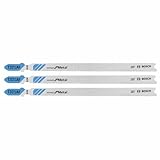
Bosch T321AF3 3 pc. 5-1/4 in. 21 TPI Speed for Metal T-Shank Jig Saw Blades
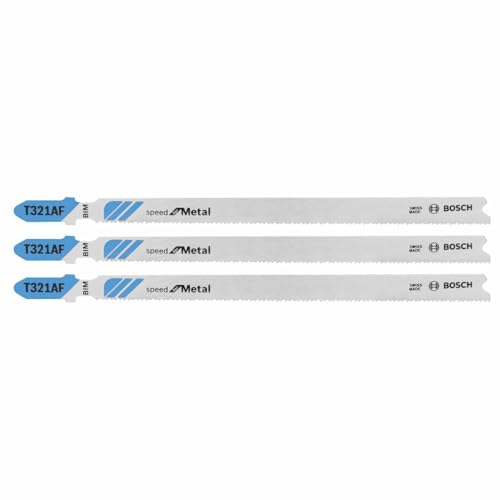
The Bosch T321AF3 3 pc. 5-1/4 in. 21 TPI Speed for Metal T-Shank Jig Saw Blades are built for cutting through metal. If you work with pipes, profiles, or sheet metal, this set is worth a close look. These blades handle ferrous and non-ferrous metals from 1/16 inch to 1/8 inch thick. They are also good for sheet metal from 10 to 16 gauge.
You can cut pipes that are less than 2-1/2 inches in diameter, tube stock, and angle iron without a problem.
The 21 TPI tooth design gives you smooth and very fast cuts. That means less time fighting with the material and more time getting the job done. The teeth are aggressive enough to chew through metal quickly, but they leave a cleaner edge than you might expect. You wont have to spend as much time cleaning up rough edges later.
These blades use bi-metal construction.
This is important because it makes the blades last longer. The high-speed steel teeth stay sharp, while the flexible steel body resists breaking. You get durability and long life from a single blade. That is a good thing when you are cutting through tough materials like angle iron or thick pipe.
The extra-long design helps a lot. Each blade has a 5-1/4 inch overall length with a 4-1/4 inch working length. That extra reach lets you cut thicker stock and get into tighter spaces.
Bosch T118GFS 5-Piece 3-1/4 in. 36 TPI Basic for Stainless Steel T-Shank Jig Saw Blades

The Bosch T118GFS 5-Piece 3-1/4 in. 36 TPI Basic for Stainless Steel T-Shank Jig Saw Blades are a practical option for cutting thin metal. If your working with stainless steel sheet metal, this set is built to handle the job. It is not a fancy or expensive blade set. It is a straightfoward, economical choice for cutting straight lines in 8 to 26 gauge stainless steel.
That covers a wide range of common metal thicknesses for repair work, ductwork, or hobby projects.
The blades have a 36 TPI (teeth per inch) configuration. This is a high tooth count. The teeth are milled and set in a wavy pattern. What does that mean for you? It means the cut will be very clean and smooth. There will be less vibration and less burring on the edge of your metal. You get a precise cut without a lot of extra filing or sanding afterward.
This is important when you need a neat finish on a project.
These blades are made with bi-metal construction. That means the body of the blade is flexible while the cutting edge is made from high-speed steel. This design gives you durability. The blade is less likely to snap under pressure, and it stays sharp longer than standard steel blades. You get good lifespans out of each blade, even when cutting through tough stainless steel.
Each blade has a 3-1/4 inch overall length.
Bosch T121AF3 3-Piece 3-5/8 In. 21 TPI Speed for Metal T-Shank Jig Saw Blades

The Bosch T121AF3 3-Piece 3-5/8 In. 21 TPI Speed for Metal T-Shank Jig Saw Blades are designed for cutting through sheet metal and thin metals with surprising speed. If you work with ferrous or non-ferrous materials, these blades are worth a closer look.
These blades are built for sheet metal between 10 and 16 gauge, as well as thin metals from 1/16-inch to 1/8-inch thick. That covers a lot of common metalworking tasks, from ductwork to automotive panels.
The 21 TPI (teeth per inch) count is high, which means you get a finer cut, but the real story is the tooth geometry. Bosch uses a unique design with both rigid and aggressive tooth profiles. This combination lets the blade cut through metal faster than a standard blade without stalling or binding.
One of the clever features here is the backward taper design. This shape simulates a pendulum motion as the blade moves through the material.
The effect is that the blade clears chips more effectively and keeps cutting smoothly. It directly increases your cutting speed, which is a big deal when you are working on a time-sensitive project.
The blades are made with bi-metal construction. This means the body is flexible to reduce breakage, while the cutting edge is hard for long life. You wont have to swap blades as often, even when cutting tougher metals.
14 PCS U-Shank Jig Saw Blade Set, Jigsaw Blades Fit Vast Majority U Shank Jigsaws, Jigsaw Blades Set for Wood, Plastic and Metal Cutting, 6T 8T 10T 14T 18T 24T 32T

The 14 PCS U-Shank Jig Saw Blade Set is a straightforward collection of jigsaw blades designed for common cutting tasks. This set includes fourteen blades total, with two blades for each of the following tooth counts: 6T, 8T, 10T, 14T, 18T, 24T, and 32T. Having two of each type means you have a backup ready when a blade gets dull or breaks. That is handy for longer projects.
These blades are made from high-quality high-carbon steel.
This material is hard and wear-resistant, so the blades stay sharp longer than cheaper options. You will not have to replace them as often during a job. The tooth design is focused on speed. Each blade is shaped to cut through materials quickly. This helps you get your work done without unneccesary delay. Whether you are making rough cuts or finishing work, the teeth are set up for efficency.
The compatibility of these blades is a key point.
They use a U-shank design, which fits the vast majority of jigsaws on the market. If you have a standard jigsaw, there is a very good chance these blades will lock right in. No special adapters or fuss. Just slide them into the collet and you are ready to go. This makes them a reliable choice for most DIYers and tradespeople.
As for application, this set is built for cutting wood, plastic, and metal. The range of tooth counts is what makes it versatile.
Jigsaw Blades For Metal Buying Guide
Cutting steel requires a specialized jigsaw blade for metal with hardened teeth. Regular wood blades will dull instantly or snap under teh pressure. You need blades designed to chew through tough material without overheating. The wrong choice leads to jagged cuts, burned edges, or broken blades. But picking the right one is simpler than you think if you focus on a few key details.
Tooth Count For Smooth Or Fast Cuts
The number of teeth per inch (TPI) changes everything. A blade with 14 to 18 TPI gives you a slower, smoother finish. Great for thin sheet metal where you want clean edges. For thicker plate steel, go with 8 to 10 TPI. It cuts faster but leaves a rougher edge. Which do you need? If you’re making visible cuts on a car panel, pick the higher TPI. If you’re hacking through structural steel, the lower count saves time. A common mistake is using a fine blade on thick metal—it binds and breaks. Match the TPI to your material thickness.
Tooth Material And Coating
All blades are not equal. High-speed steel (HSS) blades work for basic metals like aluminum or thin steel. But for harder stuff like stainless steel or thick plates, you want bi-metal blades. They combine a flexible body with hardened teeth that resist snapping. Some blades also have a titanium coating. This reduces friction, keeps the blade cooler, and extends its life. If you cut metal often, the extra cost for bi-metal is worth it. You’ll change blades less and avoid the hassle of mid-cut failures.
Shank Type For Your Jigsaw
Your jigsaw determines which shank fits. Most modern saws use a T-shank (universal) blade. It locks in securely and swaps out quickly. Older tools might use a U-shank design. Check your saw’s manual before buying. A loose blade wobbles and ruins your cut line. Always match the shank to your tool for stability. One small mismatch and you’re fighting the saw instead of working with it.
Blade Length And Thickness
Longer blades reach through thicker material but can be flimsy. A 4-inch blade is standard for most metal cutting. For metal over 1/4 inch thick, choose a 5-inch blade to ensure full penetration. Thicker blades also reduce bending during cuts. They stay straighter and give you better control. Thin blades flex too much, especialy on curves. Pick a sturdy one for straight cuts and a flexible one for tight curves in thin metal.
Frequently Asked Questions About Jigsaw Blades For Metal
What type of jigsaw blade is best for cutting metal?
Pick a blade made from high-speed steel or bi-metal. These materials handle the heat and hardness of metal well. Look for blades with a fine tooth count. A TPI of 14 to 24 works great for most metal jobs. The blade should also have a “ground” or milled tooth set for cleaner cuts.
How do I choose the right TPI for metal cutting?
TPI stands for teeth per inch. For thin metal like sheet steel, go with a high TPI around 20 to 24. This gives you a smooth cut. For thicker metal like pipes, use a lower TPI of 14 to 18. It cuts faster but leaves a rougher edge. Allways match the TPI to the metal thickness for best results.
Can I use a wood-cutting jigsaw blade on metal?
No, you shouldn’t. Wood blades have fewer teeth and are softer. They dull quickly on metal and can cause rough cuts. Metal blades are harder and have more teeth. They grip the metal better and reduce vibration. Stick with blades made for metal to avoid damage or injury.
Do I need to lubricate the blade when cutting metal?
Yes, it helps a lot. Lubrication reduces heat and friction. This keeps the blade sharp longer and prevents the metal from warping. Use cutting oil or even a bit of water. Apply it lightly to the cut line as you work. Just be careful not to overdo it, or things get messy.
What shank type should I look for?
Most jigsaws use a T-shank blade. It’s secure and easy to change. U-shank blades are older and less common. Check your jigsaw’s manual to be sure. T-shank is the standard for most modern tools, so it’s a safe bet.
How do I prevent the blade from breaking?
Use the right speed and pressure. Run the jigsaw at a medium to slow speed. Let the blade do the work. Pushing to hard can snap it. Also, support the metal well so it doesn’t vibrate. Clamp it down if you can. This stops the blade from binding and breaking.
Why is my cut so rough on metal?
You might be using the wrong blade or speed. Check your TPI—too low makes rough cuts. Also, make sure the blade is sharp. Dull blades tear the metal. Finally, go slower. Rushing leads to chattering and a messy edge. Practice on scrap first if you’re unsure.
Closing Thoughts
This article has covered the essential information you need to make an informed decision. We’ve examined the key features and considerations that matter most when choosing the right product for your needs.
When thinking about jigsaw blades for metal, remember to focus on what works best for your specific situation. The ideal choice depends on your individual requirements and preferences. Take your time to evaluate all the options carefully.